Dirt, Creepers, and Infinite Sky: Why Minecraft's Ugly Little World Swallowed the Early 2010s Whole
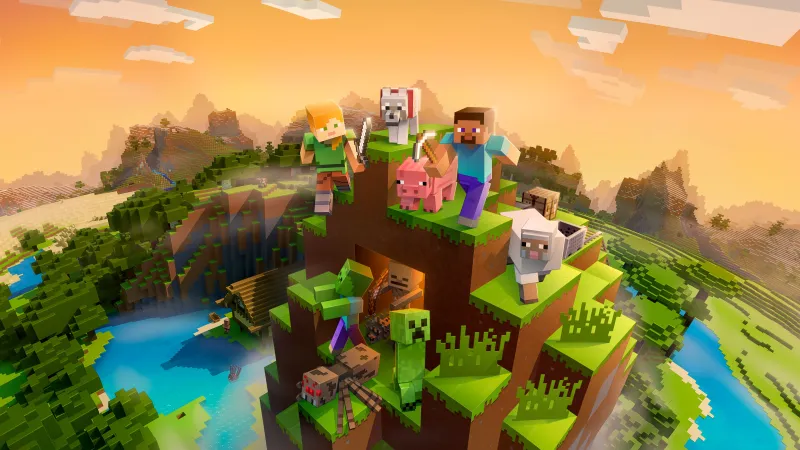
Photo: Minecraft blocky landscape building blocks game 2010s screenshot colorful, via store-images.s-microsoft.com
Picture the gaming landscape of 2010. Call of Duty: Black Ops was selling in numbers that bordered on geological. Halo: Reach had a cinematic campaign with production values that could make a grown adult tear up. The graphics card arms race was in full swing, and every major studio was chasing photorealism like it was the finish line of a very expensive marathon.
And then there was Minecraft. A game that looked like someone had digitized a fever dream about Legos. A game with no tutorial, no main quest, no cutscenes, and no explanation whatsoever of what you were supposed to be doing. A game where the most dangerous enemy was essentially an animate green cucumber that blew up if it got too close to you.
It became one of the best-selling games in human history. Obviously.
The Anti-Game That Won Everything
Minecraft's early access release in 2009 and its full launch in November 2011 arrived at a specific cultural moment when a certain kind of gamer — smart, slightly contrarian, tired of being told exactly what to do and where to go — was desperately looking for an exit ramp from the hyper-produced AAA experience.
The game's creator, Markus Persson (better known as Notch), built Minecraft almost entirely alone, and it showed — in the best possible way. The world was generated procedurally, meaning every map was unique. The rules were minimal. You punched trees to get wood. You used wood to make tools. You used tools to dig deeper, build higher, and survive the first night before the skeletons and zombies showed up. That was more or less the entire instruction manual.
What players discovered was that the absence of a prescribed goal wasn't a bug — it was the whole experience. Minecraft handed you an infinite world made of blocks and said, essentially, figure it out. For a generation that had grown up with mission markers and objective arrows and games that held your hand across the entire experience, this was genuinely startling. It was also, for many people, deeply liberating.
The YouTube Pipeline That Changed Everything
Minecraft might have stayed a beloved niche game if not for one critical development: it turned out to be extraordinarily compelling to watch other people play it.
This sounds insane. It was, in retrospect, the harbinger of an entirely new entertainment category. But in 2010 and 2011, watching a YouTube Let's Play of Minecraft wasn't just passive entertainment — it was a masterclass in possibility. You'd watch someone like CaptainSparklez or the early days of the Dream SMP precursors, and they'd be building something you hadn't conceived of. An underwater glass dome. A functional clock tower. A pixel-art recreation of the Eiffel Tower rendered in wool blocks.
The game's visual simplicity was a feature here, not a limitation. Because everything was made of the same chunky blocks, creations had a folk-art quality that made them feel achievable. You watched someone build a cathedral and thought: I could do that. The gap between spectator and creator felt genuinely small. The next day, you were back in your own world, attempting your own cathedral, usually failing in interesting ways, and then watching more videos to figure out where you went wrong.
This feedback loop — play, watch, learn, play again — was something the gaming world hadn't really seen at that scale before. Minecraft essentially bootstrapped the Let's Play genre into mainstream relevance.
The Server World Was Its Own Internet
But the single-player experience was only half the story. Minecraft servers — player-run multiplayer worlds — became their own weird civilization during the early 2010s, and the social dynamics that emerged from them deserve their own sociology dissertation.
There were survival servers where loose alliances formed and collapsed over diamond deposits. There were creative servers where builders staked out territory and developed reputations for architectural excellence. There were mini-game servers running Hunger Games-style competitions before The Hunger Games movie had even come out. There were faction servers that developed genuine political intrigue — betrayals, wars, diplomatic incidents over stolen resources.
Kids were logging in after school not primarily to build, but to hang out. The game was the venue; the social experience was the point. In an era before Discord, before widespread voice chat normalization, Minecraft servers were filling a specific social need for a generation of young people who wanted a shared space that felt like theirs rather than something handed down by adults.
The IP address of a good server was social currency. Knowing the right servers put you in the right conversations. Getting banned from a server was a genuine minor tragedy.
Why Blocky Felt Better Than Beautiful
Here's the counterintuitive truth about Minecraft's aesthetic that took a while to articulate: the low-fi visuals weren't a compromise, they were a creative invitation.
High-resolution photorealistic games of the era were closed in a certain way. You couldn't reshape the world. You couldn't leave a mark. You moved through them like a tourist through a museum — impressed, maybe, but fundamentally uninvested in the landscape's permanence. When you logged off, the world was exactly as you'd found it.
In Minecraft, you owned what you built. The rough, blocky aesthetic meant that every player's creation had the same visual grammar as the generated world around it. Your dirt house looked like it belonged. Your cobblestone tower looked like it had always been there. The game's ugliness was democratizing — nobody's creation looked worse than the terrain, and nobody's creation looked unbelievably better than yours. Everyone was working with the same chunky crayons.
What It Left in the Ground
By 2013, Minecraft had sold tens of millions of copies across PC, mobile, and console. Microsoft would buy the entire thing for $2.5 billion in 2014, which remains one of the more surreal sentences in gaming history.
But the early 2010s Minecraft era — pre-acquisition, pre-education edition, pre-official merchandise empire — had a specific energy that those who were there still talk about. It was a game that felt discovered rather than marketed. It spread through word of mouth and YouTube rabbit holes and friends leaning over to show you something on their laptop screen.
It was a blocky, unpolished, procedurally generated reminder that sometimes the best worlds are the ones that give you just enough structure to start building and then get completely out of your way.
Also the Creeper was terrifying and we will not be taking questions at this time.